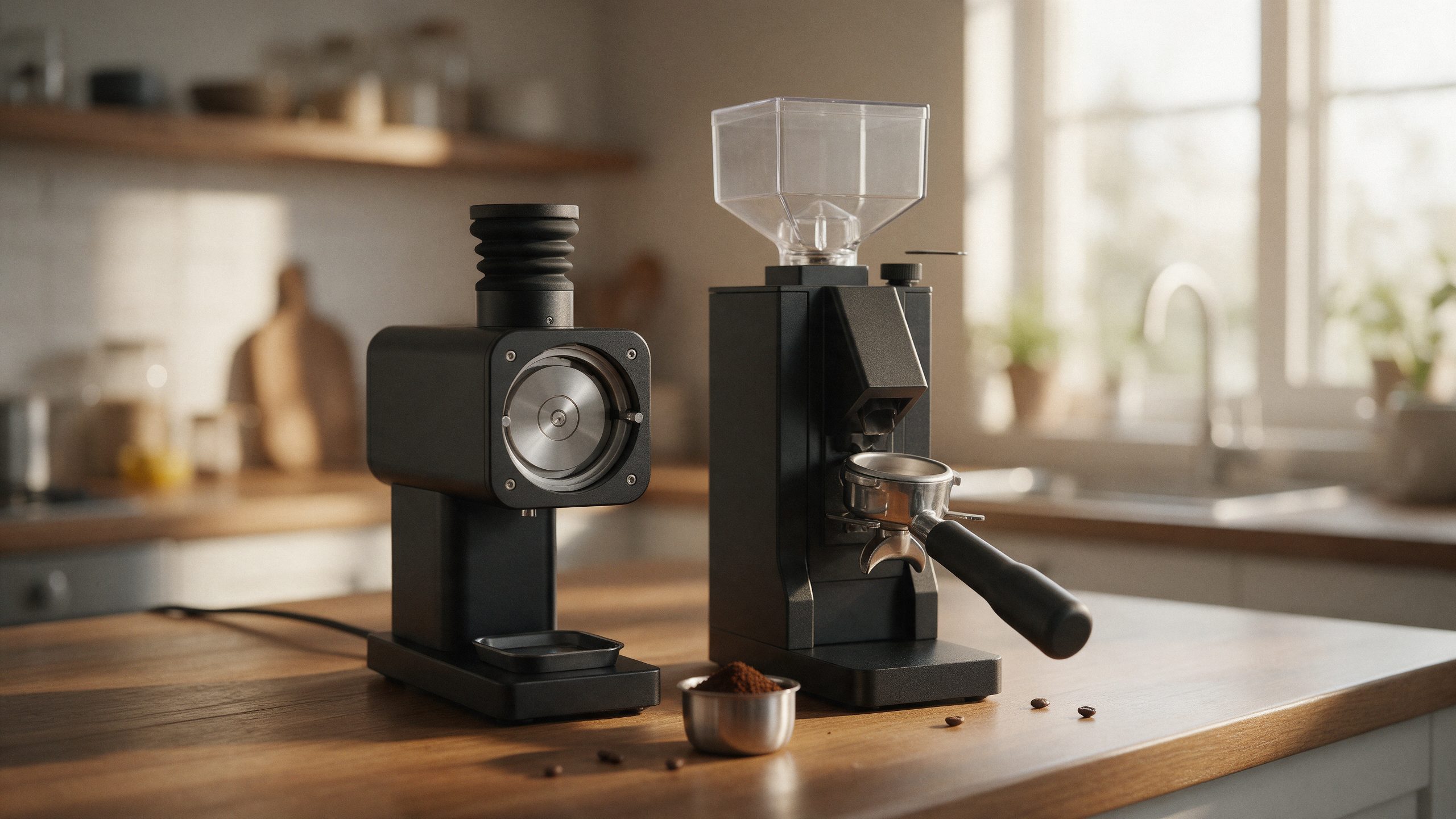
The best espresso grinder under $500 has to do one thing a cheap grinder can’t: move in steps small enough to change a shot by a few seconds. Most of the money goes there. This roundup picks five grinders that reach espresso fineness with room to adjust, from the $199.95 Baratza Encore ESP to a 64 mm flat-burr single doser at $354. We haven’t pulled shots through them here. Every spec below comes from the maker’s own page, or from a US dealer where the maker doesn’t sell direct, and anything we infer from those specs is labeled as reasoning.
Short answer
For most people, the best espresso grinder under $500 is the Baratza Sette 270 ($399.95): it grinds straight into the portafilter, stores three timed doses, and pairs macro steps with a stepless micro adjust. If you’d rather weigh each dose and want flat burrs, the Turin DF64 Gen 2 ($354) puts 64 mm burrs under $400. On a tight budget, the Baratza Encore ESP ($199.95) reserves half of its 40-step dial for espresso.
Documented. Prices, burr sizes, adjustment systems, motors, dimensions and warranties come from Baratza’s and Turin’s US stores and from Eureka’s own site, checked in September 2026. Eureka doesn’t sell direct in the US, so the Silenzio 55 price is Whole Latte Love’s. Three of the five were marked down against a crossed-out price when we looked, so read every price as the price on that date. Where a maker doesn’t publish a figure, like retention in grams or noise in decibels, we say so instead of filling it in. Sections marked Reasoned explain what a spec changes at the machine; they are not results we measured. The method is on our how we test page.
The five picks at a glance
| Model | Burrs | Adjustment | Feed | Dosing | ||
|---|---|---|---|---|---|---|
| Baratza Sette 270 | $399.95 | 40 mm conical | Macro steps + stepless micro | Hopper, 300-400 g | 3 timed presets, portafilter holder | Check price |
| Turin DF64 Gen 2 | $354.00 | 64 mm flat | Stepless | Single dose, 50 g bellows | Auto stop at 45 s, 58 mm cup | Check price |
| Eureka Mignon Silenzio 55 | $449.00 | 55 mm flat | Stepless | Hopper, 300 g | Timed or manual, hands-free fork | Check price |
| Turin DF54 | $225.00 | 54 mm flat | Stepless | Single dose, 20 g (50 g with bellows) | Manual on/off, 58 mm cup | Check price |
| Baratza Encore ESP | $199.95 | 40 mm conical | 40 steps, 1-20 for espresso | Hopper, 300 g | On/off + pulse, 54 mm cup (58 mm adapter) | Check price |
What $500 buys in an espresso grinder
Reasoned. Adjustment comes first. A shot runs through the puck in 25 to 30 seconds, and a small change in grind size can move that by several seconds either way. A filter grinder with wide steps jumps right past the setting you need. Every grinder here either has steps built for espresso (the Encore ESP’s micro range, the Sette’s micro adjust) or no steps at all. Stepless isn’t automatically better. It just means you choose the size of each move. Our grinder buying framework goes through that trade in more detail.
Then the burrs. Under $500 you get two shapes: 40 mm conical burrs in the two Baratzas, and flat burrs from 54 to 64 mm in the two Turins and the Eureka. The shapes cut differently, and we lay out what that does and doesn’t change in the cup in conical vs. flat burrs for espresso. A bigger burr isn’t a quality score on its own. At this price the conical grinders are also the ones with the better dosing features, so it’s a trade, not a ladder.
Last, how the coffee goes in. A hopper holds beans and you grind by time. A single-dose grinder takes the beans you weighed and, in theory, hands the same weight back. Turin publishes retention claims for both its grinders, Baratza says its grinders minimize what’s left inside without giving a number, and Eureka gives no retention figure for the Silenzio 55. That makes retention the one spec you can’t fully compare on paper.
1. Baratza Sette 270: best espresso grinder under $500 overall
Documented. Baratza’s US store lists the Sette 270 at $399.95. It grinds on 40 mm conical steel burrs made by Etzinger. You set it with macro steps plus what Baratza calls a “step-less micro adjust with 9 indicators”; the product sheet counts 30 macro steps and the manual 31, and the manual puts espresso at settings 3 to 9. A digital timer stores three programmable presets, and the holder arms take portafilters “from sizes 49mm to 58mm”, with a grounds bin for other brews. The hopper holds 10 oz, which Baratza gives as 300 to 400 g. The DC motor is rated at 200 W; Baratza doesn’t publish the RPM or a noise level. On retention, it says only that the Sette “minimizes the ground coffee left in the grinder.” The grinder is 13 cm wide, 24 cm deep and 40 cm tall, weighs 3.2 kg (7 lb), and has a one-year warranty in the US and Canada. The manual also lists an espresso duty cycle of 10%.
Reasoned. Workflow is why it’s first. Portafilter in the arms, press a preset, and the dose lands where it needs to be. No cup to tip, no transfer. That’s the routine most people buying their first real grinder are after, and seven espresso settings, each split by the micro adjust, leave plenty of room to dial in. Timed doses do drift a little as beans age, so an espresso scale still earns its place. The limits are on the spec sheet too. At 40 cm it’s the tallest grinder here, so measure the space under your cabinets. And a 10% duty cycle describes a motor meant for a dose or two with a rest in between, not a week of beans in one go. The rest of the numbers are in our Sette 270 spec review.
2. Turin DF64 Gen 2: best flat-burr single doser under $500
Documented. Turin’s US store sells the DF64 Gen 2.7, the current version of the Gen 2, for $354 against a crossed-out $599, with coated burrs $25 more. It grinds on 64 mm stainless-steel flat burrs with stepless adjustment. The 250 W motor starts by hand and stops on its own after 45 seconds. There’s no timer: you weigh the beans in and grind the whole dose. The 50 g bellows hopper is built for single dosing, and Turin calls the DF64 “a low retention grinder” where the amount retained “is usually a percentage of a gram.” A 58 mm aluminum dosing cup comes in the box. It measures 10 in long, 5.2 in wide and 12 in tall, weighs 15 lb, and has a one-year warranty serviced in the US by Espresso Outlet.
Reasoned. This is the most burr for the money in the group, 64 mm for less than the Sette costs. Judge it at $354; the crossed-out $599 isn’t a price anyone is asked to pay. Single dosing suits you if you change beans often or only pull a shot or two a day, since nothing waits in a hopper going stale. The price of that is a longer routine: weigh, grind, tap the bellows, and usually stir the grounds with a WDT tool before tamping. It’s also the heaviest grinder here at 15 lb, which you’ll notice only once, when you set it on the counter.
3. Eureka Mignon Silenzio 55: the quiet hopper grinder
Documented. Eureka has no US web store. Whole Latte Love sells the Silenzio 55 for $449, down from a crossed-out $499, and Seattle Coffee Gear had it at $399 on pre-order when we checked. Eureka’s own page gives 55 mm hardened-steel flat burrs, a “Stepless Micrometric Regulation System”, a 310 W motor at 1,350 RPM and a 300 g hopper. You grind manually or by timer from a touch display (Whole Latte Love gives the timer range as 2 to 20 seconds), with a hands-free fork that holds the portafilter. Eureka markets a “Silent Technology” that “significantly reduces grinding noise” but publishes no decibel figure, and no retention figure either. The grinder measures 120 x 140 x 350 mm and weighs 5.6 kg (12.34 lb). US dealers give a one-year parts and labor warranty. Watch the name when you shop: Whole Latte Love also sells an older 50 mm model called simply “Mignon Silenzio” for $349. It’s a different grinder.
Reasoned. Think of it as the Sette’s routine with flat burrs: beans in the hopper, a timed dose, the portafilter in the fork. At 12 cm wide it’s narrow for a 55 mm flat-burr grinder, which helps on a crowded counter. Quiet is the selling point, and it’s the one claim we can’t check on paper, since there’s no dB figure to compare. Still, if noise matters in your house (an early start, a sleeping baby, thin walls), this is the only grinder here whose maker puts it in the headline. Eureka sells the same body with two programmable doses as the Specialità, which sits above this budget; more on it below.
4. Turin DF54: best espresso grinder under $250
Documented. Turin sells the DF54 v4.1 for $225, down from a crossed-out $249. It has 54 mm stainless-steel flat burrs and a stepless dial. Turin’s product page lists the motor as 150 W in the specs and 250 W in its FAQ, which also gives a fixed speed of about 1,400 RPM, so we can’t tell you which wattage is right. The hopper holds 20 g, or 50 g with the bellows, and Turin claims retention of “less than 0.1 gram, without requiring a bellow.” Grinding is manual on and off, with no timer. A 58 mm plastic dosing cup is included. It’s 4.5 in wide, 7 in deep and 12 in tall, weighs 10 lb, and carries a one-year warranty.
Reasoned. For about the price of an Encore ESP and a basic scale, you get flat burrs and single dosing. What you give up is polish: a plastic cup, no timer, and a spec page that can’t agree with itself about the motor. None of that stops it grinding for espresso, and Turin’s retention claim is the boldest in the group. It’s also the narrowest grinder here at 4.5 in. If you’re building a first setup on a budget and don’t mind weighing every dose, start here.
5. Baratza Encore ESP: best espresso grinder under $200
Documented. Baratza lists the Encore ESP at $199.95. It uses 40 mm M2 conical burrs in hardened alloy steel from Etzinger. The dial has 40 steps: settings 1 to 20 are “micro-steps… for high resolution espresso grinding”, and 21 to 40 are macro steps for filter coffee. The 70 W motor runs from an on/off switch or a pulse button, with no timer. The hopper holds 300 g and the bin 120 g, and the anti-static dosing cup fits 54 mm baskets, or 58 mm with the included adapter. Baratza says the Encore ESP “minimizes the ground coffee left in the grinder.” It measures 13 x 15 x 34 cm. Baratza’s two product sheets disagree on the weight, 3.1 kg in one and 2.5 kg in the other. The warranty is one year.
Reasoned. The split dial is what makes it an espresso grinder. Half the range sits where espresso lives, in small steps, and the other half still covers pour-over and drip. You give up comfort at the dosing stage: no timer and no holder, so you grind into the cup and check the weight on a scale. For a first machine with a 54 mm portafilter, like a Breville Bambino or Barista Express, it’s the grinder we’d look at first, and it’s the one we paired with a Bambino in our beginner machine picks. The full breakdown is in our Encore ESP spec review.
Also considered
Documented. The Eureka Mignon Specialità is the Silenzio 55’s better-known sibling: the same 55 mm burrs, 310 W and 1,350 RPM per Eureka, the same 120 x 140 x 350 mm body, plus two programmable doses. It was $549 at Whole Latte Love, Seattle Coffee Gear and Clive Coffee, so it misses this budget by $49. The Fellow Opus 2 ($199.95, or $249.95 for the premium version) is a 48 mm conical single doser with 48 settings on a stepless dial, and the only grinder we looked at with a two-year warranty. Fellow says it’s “designed to handle the full range, from espresso to cold brew”; we kept the Encore ESP instead because its dial sets aside a documented espresso range. The Timemore Sculptor 064S was $599 and sold out, and Breville listed its Smart Grinder Pro at $199.95 but out of stock.
Single dose or hopper: which fits your mornings?
Reasoned. Pick the routine before the burrs. A hopper grinder (the Silenzio 55, the Encore ESP) suits one coffee at a time and the same drink every day: fill it, set a time, grind. Beans in a hopper sit in the open, so keep it low if you don’t go through much coffee. The Sette 270 sits in between: it has a hopper, but its straight-down grind path also takes single doses well, as our Sette review explains. A single-dose grinder (both Turins) suits people who switch beans or pull one shot a day: weigh 18 g, grind 18 g, and nothing is left waiting. The cost is a few extra steps every single time. Neither is right for everyone, and our guide to choosing an espresso grinder walks through the decision.
Check the portafilter while you’re at it. If your machine takes a 54 mm portafilter, the Encore ESP’s cup is the only one here sized for it out of the box. The Turins ship 58 mm cups, and the Sette and the Eureka hold the portafilter itself. Not sure which size you have? Our portafilter sizes guide lists it by machine.
Which one should you buy?
- You want to press a button and have the dose land in the portafilter: the Baratza Sette 270.
- You want flat burrs, single dosing and the most burr for the money: the Turin DF64 Gen 2.
- You want a hopper, flat burrs and a grinder built to be quieter: the Eureka Mignon Silenzio 55.
- You’ll weigh every dose anyway and want to spend about $225: the Turin DF54.
- You’re buying your first espresso setup and the grinder has to cost $200: the Baratza Encore ESP.
Reasoned. If one budget has to cover the machine and the grinder, give the grinder more of it than feels natural. A capable grinder on a modest machine can be dialed in; a modest grinder holds back even a good machine. Once the grinder is on the counter, the espresso dial-in chart shows which variable to move first, and the under- vs. over-extraction guide explains what a grind change does in the cup.
Frequently asked questions
What is the best espresso grinder under $400?
Documented. Two of the five were under $400 at September 2026 prices: the Baratza Sette 270 at $399.95 and the Turin DF64 Gen 2 at $354. Reasoned. Choose the Sette for timed dosing straight into the portafilter, the DF64 for flat burrs and single dosing.
Is a $200 grinder good enough for espresso?
Reasoned. It can be, if it was designed for espresso. The Encore ESP gives espresso 20 of its 40 steps, and the DF54 is stepless. What a grinder at that price usually gives up is convenience, not fineness: no timer, no holder, more handling. The one to avoid is a general-purpose grinder with wide steps. Our grind size by brew method guide shows how much finer espresso sits than filter coffee.
Stepped or stepless: which is better for espresso?
Reasoned. Either works if the steps are small enough. Stepless lets you move by any amount but gives you no clicks to count back to a setting you liked. Small steps are easier to repeat and to write down. The Sette 270 does both, with macro steps and a stepless micro adjust on top.
Flat or conical burrs under $500?
Documented. In this group the conical options are the two Baratzas at 40 mm, and the flat ones run from 54 to 64 mm. Reasoned. Burr shape changes the spread of particle sizes, which we explain in conical vs. flat burrs. At this price, though, the dosing routine and the adjustment will shape your mornings more than the geometry will.
The short version
For most kitchens, the best espresso grinder under $500 is the Baratza Sette 270: timed doses straight into the portafilter and fine adjustment where espresso lives, for $399.95. The Turin DF64 Gen 2 is the flat-burr single-dose pick at $354, and the Eureka Mignon Silenzio 55 is the hopper grinder built to be quieter, at $449. On a smaller budget, the Turin DF54 at $225 and the Baratza Encore ESP at $199.95 both grind fine enough for espresso, with less help at the dosing stage. This page is built on manufacturer documentation, not a bench test we ran; see how we evaluate gear we haven’t bench-tested for the method.