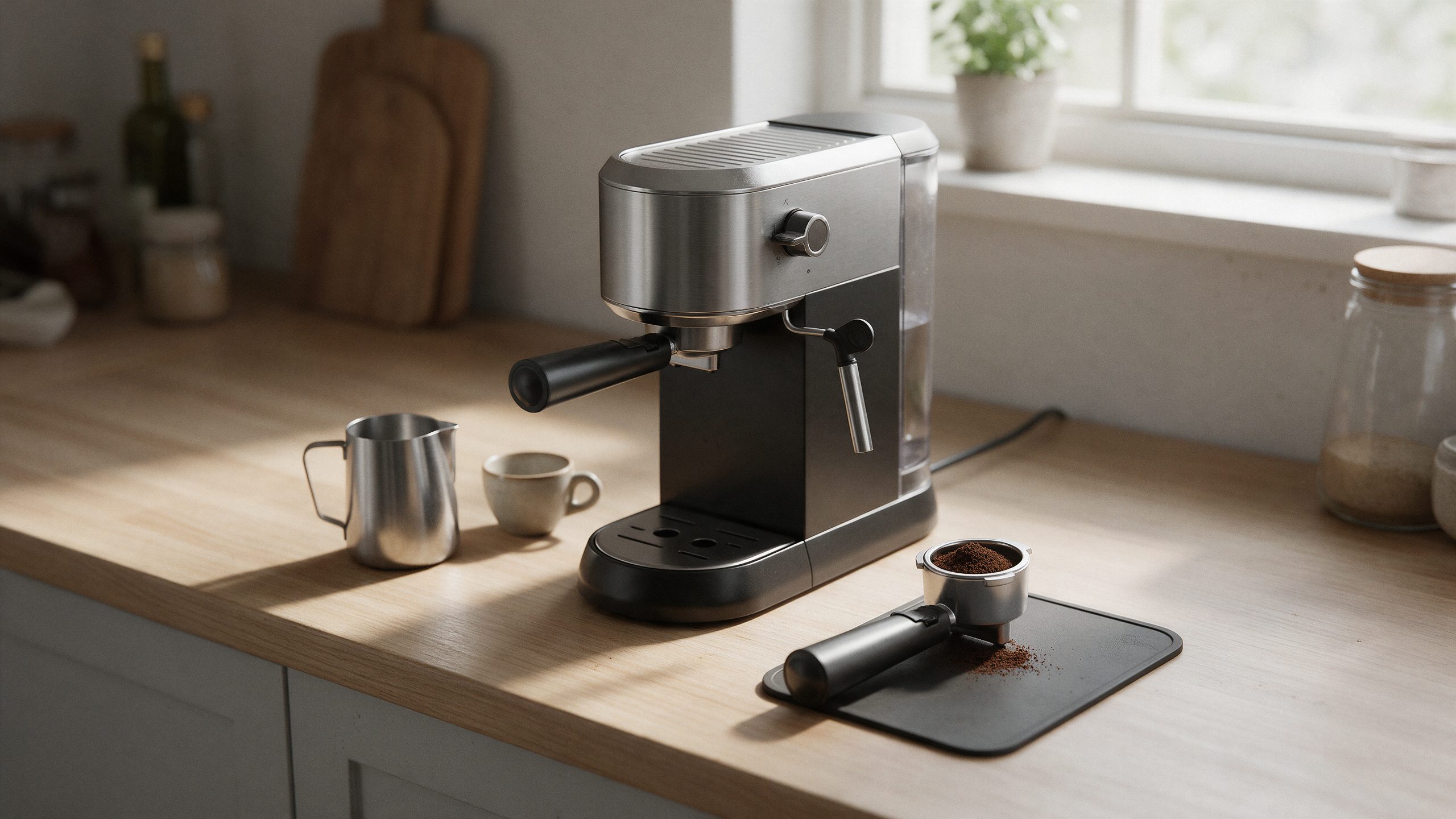
Most lists of the best espresso machine for beginners are written by people who stopped being beginners a long time ago. They rank machines on shot quality, which is the one thing a first-timer can’t judge yet. This roundup starts from the other end. What does a first machine have to forgive, and which five models are built to forgive it? We haven’t pulled shots on these machines here, so every claim below either names its source or explains the mechanism behind it, and it’s labeled accordingly.
Short answer
For most people, the best espresso machine for beginners is the Breville Bambino Plus ($499.95): ready in 3 seconds, dual-wall baskets that tolerate pre-ground coffee, and an automatic steam wand that textures milk for you. The plain Bambino does the same espresso work for $299.95 if you’ll steam by hand. The Gaggia Classic Evo Pro is the pick if you’d rather learn on a commercial-size 58mm group from day one.
Documented. Specs and prices come from each manufacturer’s US product page, checked in September 2026, plus Whole Latte Love’s listing for the Gaggia’s basket set and warranty. Prices move, so read them as list prices on that date, not as today’s deal. Sections that explain why a feature matters to a beginner are marked Reasoned: they describe cause and effect, not a result we measured. The method behind that split is on our how we test page.
The five picks at a glance
| Model | Heats with | Portafilter | Milk | Grinder | ||
|---|---|---|---|---|---|---|
| Breville Bambino Plus | $499.95 | ThermoJet, 3 s | 54mm | Automatic wand | No | Check price |
| Breville Bambino | $299.95 | ThermoJet, 3 s | 54mm | Manual wand | No | Check price |
| Breville Barista Express | $699.95 | Thermocoil, PID | 54mm | Manual wand | Conical burr, 16 settings | Check price |
| Gaggia Classic Evo Pro | $549.00 | Brass boiler, 3.5 oz | 58mm | Manual wand | No | Check price |
| De’Longhi Stilosa | $149.95 | Stainless steel boiler | 51mm (aftermarket sizing) | Manual wand | No | Check price |
What makes a beginner espresso machine forgiving
Reasoned. A first espresso setup fails in predictable places. The grind is wrong because you don’t have a proper grinder yet. The tamp is uneven because you’ve done it six times. The milk screams and turns to bubbles. A good beginner machine takes at least one of those failure points off the table while you learn the others.
The biggest one is the basket. A dual-wall (pressurized) basket has a second floor with a single small exit hole, so the resistance a shot needs comes from the basket rather than from the coffee. Pre-ground or slightly-off coffee still produces a drinkable shot with foam on top. The catch is that the foam is partly manufactured by that hole, which is why crema from a pressurized basket tells you less than it seems to. A single-wall basket puts all the resistance on your grind and your puck. That’s the real skill, and a machine that ships with both lets you start on the forgiving one and switch when you’re ready, without buying anything.
Pre-infusion matters for a similar reason. Wetting the puck at low pressure before full pressure arrives gives water a gentler first contact with coffee that may not be perfectly level, and an uneven puck is exactly how channeling starts. Heat-up time is the unglamorous one. A machine that is ready in seconds gets used on a weekday morning; one that asks you to plan ahead often doesn’t. And portafilter size decides your upgrade path later, because baskets and tampers are made for one diameter only. Our guide to portafilter sizes covers that in detail.
1. Breville Bambino Plus: best for most beginners
Documented. Per Breville’s US product page, the Bambino Plus lists at $499.95. Its ThermoJet heating system reaches extraction temperature in 3 seconds. A 15 bar Italian pump runs a low-pressure pre-infusion followed by 9 bar extraction, through a 54mm stainless steel portafilter. The box includes 1-cup and 2-cup baskets in both single-wall and dual-wall versions. The automatic steam wand offers 3 milk temperatures and 3 texture levels, and the machine measures 11.9 x 7.4 x 14.3 in.
Reasoned. This is the default pick because it removes two failure points at once. The dual-wall baskets cover the grind problem while you sort out a grinder, and the automatic wand covers milk, which is the skill most people underestimate. You can drink a decent flat white in week one and learn the manual side later. The trade-offs are real, though. An automatic wand teaches you nothing about steaming, and $500 is before you’ve spent a cent on a grinder. If you mostly drink espresso straight, you’re paying $200 for a feature you won’t use.
2. Breville Bambino: the same espresso side for $200 less
Documented. The Bambino lists at $299.95. Breville gives it the same ThermoJet system with the same 3-second heat-up, the same low-pressure pre-infusion followed by 9 bar extraction, and the same 54mm portafilter with 1-cup and 2-cup baskets in single-wall and dual-wall versions. It’s narrower at 11.9 x 6.1 x 13.5 in. The difference is the steam wand, which is manual: you control the texture yourself.
Reasoned. On paper, the espresso side of the Bambino and the Bambino Plus is identical. What the extra $200 buys is automatic milk. For someone who drinks espresso, americanos or the occasional cortado, that money does far more as part of a grinder budget. If you want lattes every day, the manual wand is learnable, but expect a few weeks of loud, bubbly milk first. We’d call this the best beginner espresso machine on value, with that one condition attached.
3. Breville Barista Express: if you don’t own a grinder yet
Documented. The Barista Express lists at $699.95. It builds in a conical burr grinder with dose control and 16 grind settings. Heating is by Thermocoil, with PID temperature control holding 200°F. Like the Bambinos, it uses a 15 bar pump with low-pressure pre-infusion and 9 bar extraction, a 54mm stainless steel portafilter, and single-wall plus dual-wall baskets. Breville includes a dosing funnel, a stainless milk jug, an integrated tamper and cleaning supplies. It is also the biggest machine here, at 15.9 x 13.1 x 12.4 in.
Reasoned. The appeal is simple: one box, one purchase, and a grinder that already fits the basket. For someone starting from zero, that removes a whole research project. The limit is resolution. Sixteen settings have to cover the full espresso range, so each step is a bigger jump than on a dedicated espresso grinder; for comparison, Baratza gives the Encore ESP 20 positions for espresso alone. The grinder is also bolted to the machine, so you can’t upgrade one without replacing both. When it needs care, our Breville descaling guide covers the procedure.
4. Gaggia Classic Evo Pro: the one to grow into
Documented. Gaggia North America lists the Classic Evo Pro (sold there as the Classic Pro E24) at $549.00 in stainless steel; Whole Latte Love had it at $499 in September 2026. It heats a 3.5 oz lead-free brass boiler, uses a 15 bar Ulka pump with the pressure valve calibrated to 9 bar, and takes a 58mm stainless steel portafilter. The steam wand is commercial-style with a 2-hole tip, and the tank holds 72 oz. Whole Latte Love lists a 7 g single basket, a 14 g double and a 14 g pressurized double in the box, a 3-way solenoid valve for dry pucks, rocker switches instead of a PID, and a 2-year parts and labor warranty. It stands 14.2 in tall and weighs 19 lbs.
Reasoned. This is the pick for someone who wants to learn espresso as a craft rather than get a good latte quickly. The 58mm group is the commercial standard, so every precision basket and calibrated tamper on the market fits it. The price of that is patience. One small boiler handles both brewing and steaming, so you switch modes and wait in between, and without a PID the brew temperature follows the heating element’s on-off cycle instead of holding a set point. None of that stops a good shot. It just means the machine asks more of you. If you think you’ll end up wanting a prosumer machine in a few years, this is the closest beginner-priced rehearsal for one, and simple boiler machines like it tend to last a long time when descaled on schedule.
5. De’Longhi Stilosa: the cheapest way in
Documented. De’Longhi’s US store lists the Stilosa (EC260BK) at $149.95. It uses a 15 bar pump and a stainless steel boiler, has a manual steam wand and a two-level cup holder for taller cups, and ships with a portafilter, a tamper, single and double filters and a measuring spoon. The warranty is 1 year, plus a second year with product registration. De’Longhi’s page doesn’t give the tank capacity or say whether the filters are pressurized. Aftermarket baskets and bottomless portafilters for it are sold in 51mm.
Reasoned. For the price of a budget grinder you get a real pump machine with a steam wand. That makes the Stilosa a cheap way to find out whether the daily ritual of espresso actually sticks before you spend $500 on it. The limits show up later. The 51mm size has the thinnest accessory market of the three common diameters, and De’Longhi doesn’t list pre-infusion, so the machine won’t soften an uneven puck the way the Brevilles are designed to. If you keep it, our De’Longhi descaling guide covers the maintenance.
Budget for the grinder, not just the machine
Reasoned. Four of these five machines have no grinder. Dual-wall baskets let you start with pre-ground coffee, but the day you switch to single-wall baskets, the grinder becomes the most important part of the setup. Beginners tend to spend the whole budget on the machine and then wonder why their shots won’t improve.
Do the math with list prices. A Bambino at $299.95 plus a Baratza Encore ESP at $199.95 comes to $499.90, which is $200 less than the Barista Express, and the grinder stays with you if you upgrade the machine later. Our framework for choosing an espresso grinder walks through what to look for at each budget.
Which one should you buy?
- You want lattes now and don’t want to learn milk first: the Breville Bambino Plus.
- You drink espresso straight and have about $500 for the whole setup: the Breville Bambino plus a grinder.
- You own no grinder and want one box: the Breville Barista Express.
- You want to learn on commercial-size gear and don’t mind waiting on a boiler: the Gaggia Classic Evo Pro.
- You aren’t sure home espresso will stick: the De’Longhi Stilosa.
Whichever you pick, the first month is mostly dialing in. Our espresso dial-in chart shows which single variable to change first when a shot goes wrong. A scale that fits on the drip tray makes that month a lot shorter; our best espresso scale roundup compares five that do.
Frequently asked questions
Is De’Longhi or Breville better for a beginner?
Reasoned. Neither brand is better across its whole lineup, so compare the specific machines. At these prices, Breville’s product pages document features the Stilosa’s page doesn’t mention: low-pressure pre-infusion, a 3-second heat-up and both basket types in the box. The Stilosa costs half as much as a Bambino. If the budget is fixed at around $150, the choice is made for you.
Do I need a separate grinder as a beginner?
Reasoned. Not on day one if your machine has dual-wall baskets, since they are designed to work with pre-ground coffee. You need one as soon as you want to use single-wall baskets, because there the grind does all the work. Pre-ground coffee also loses aroma fast once the bag is open, which is a second reason most people buy a grinder within a few months.
Is a 15 bar pump better than 9 bar?
Documented. Breville lists a 15 bar pump and 9 bar extraction on all three of its picks, and Gaggia lists a 15 bar Ulka pump with the pressure valve calibrated to 9 bar. Reasoned. The 15 is what the pump can produce; the 9 is what reaches the coffee. A higher number on the box is not a sign of better espresso.
Should a beginner buy a super-automatic instead?
Reasoned. If you want coffee at the push of a button and have no interest in the process, yes, that’s a different and reasonable purchase. This list is for people who want to make espresso by hand and get better at it. A super-automatic grinds, doses and tamps for you, which is the whole point of it and also why there is nothing to learn.
The short version
The best espresso machine for beginners is the one that forgives what you can’t do yet. For most people that’s the Breville Bambino Plus. If milk isn’t the priority, the Bambino plus a grinder is the smarter $500. The Barista Express makes sense if you want one box, the Gaggia if you want to learn the hard way on gear you won’t outgrow, and the Stilosa if you’re still testing the habit. This page is built on manufacturer documentation, not a bench test we ran; see how we evaluate gear we haven’t bench-tested for the method.