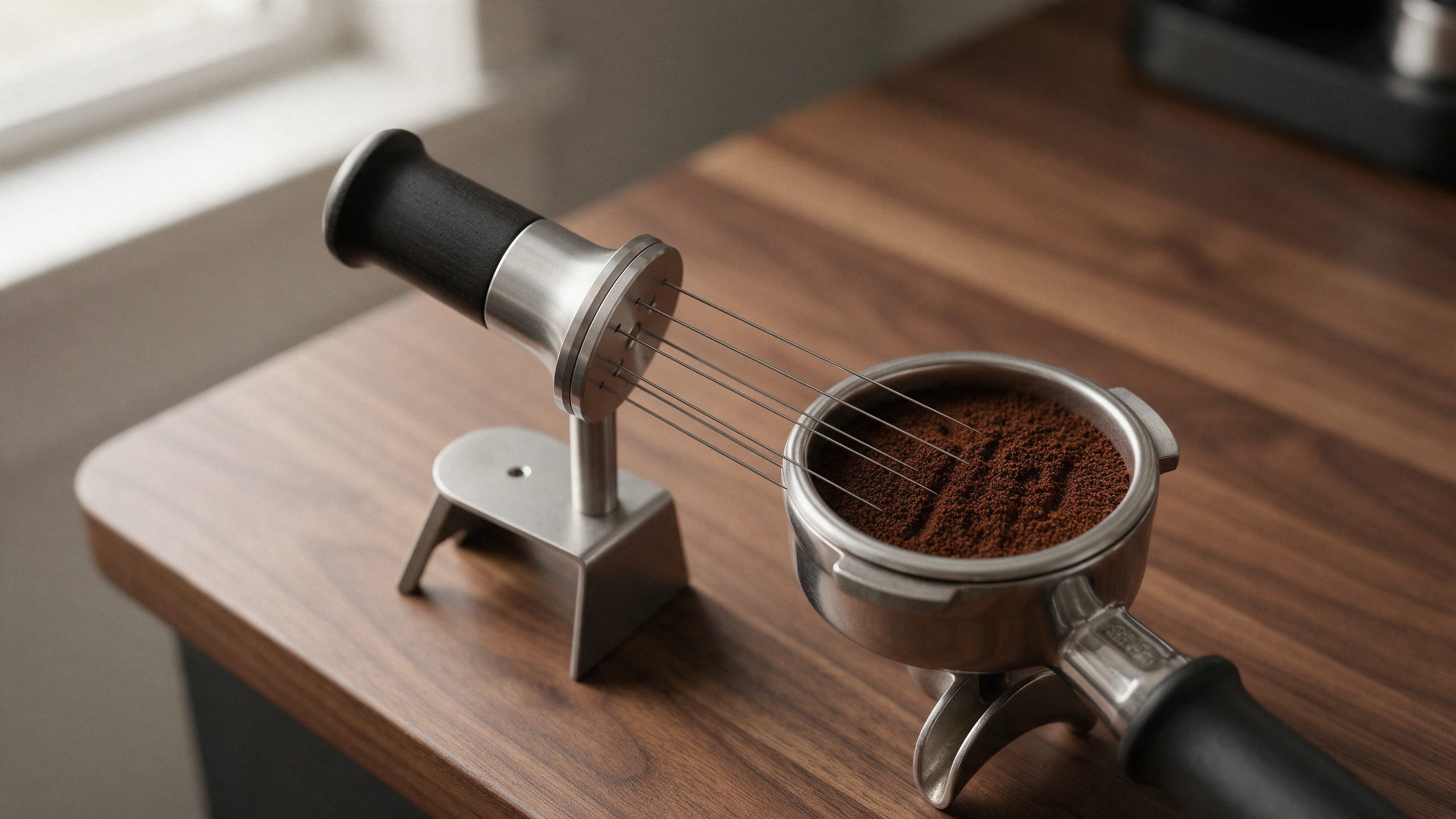
The best WDT tool has needles thin enough to split clumps, long enough to reach the floor of the basket, and a way to store it that you won’t mind every morning. Most tools get the first two roughly right, so the real differences are needle diameter, storage, and whether you can replace a needle once it bends. This roundup picks five, from a $19 tool with 0.25 mm needles to a $285 gear-driven distributor for 58 mm baskets. We haven’t stirred a dose with any of them here. Every spec below comes from the maker’s own product page, or from the US retailer that sells it, and anything we infer from those specs is labeled as reasoning.
Short answer
For most people, the best WDT tool is the Normcore WDT Tool V3 ($36.99): nine replaceable needles, with both a 0.25 mm and a 0.3 mm set in the box, plus a stand. If you want the needles hidden between shots, the Subminimal Flick ($29) retracts them with one click. On a tight budget, the Flair WDT Tool ($19) has seven 0.25 mm needles, though you can’t replace them.
Documented. Prices, needle counts, diameters, lengths and box contents come from the US stores of Normcore, Subminimal, Flair and Weber Workshops, and from Clive Coffee for the LUCCA tool, checked in September 2026. Normcore shows its price against a crossed-out $49.99, so read every price as the price on that date. Where a maker doesn’t publish a figure, like the needle length of the LUCCA or a warranty for most of these tools, we say so instead of filling it in. Sections marked Reasoned explain what a spec changes when you stir a dose; they are not results we measured. The method is on our how we test page.
The five picks at a glance
| Model | Needles | Diameter | Needle length | Storage | ||
|---|---|---|---|---|---|---|
| Normcore WDT Tool V3 | $36.99 | 9, replaceable | 0.25 mm and 0.3 mm sets | 50 mm wire | Stand | Check price |
| Subminimal Flick | $29.00 | 6, replaceable | 0.5 mm fitted, 0.35 mm spares | 42 mm | Retracts; stand + magnetic mount | Check price |
| Flair WDT Tool | $19.00 | 7, not replaceable | 0.25 mm | 38 mm | Pedestal | Check price |
| LUCCA WDT Tool | $45.00 | 8 | 0.4 mm | Not published | Stainless steel stand | Check price |
| Weber Workshops Moonraker | $285.00 | 10 fitted, 20 spares | 0.3 mm and 0.2 mm | Long and short | Aluminum caddy; 58 mm baskets only | Check price |
What to check before you buy a WDT tool
Documented. Needle diameter comes first. Our guide to what a WDT tool fixes covers the mechanism: the needles have to shear clumps apart without packing the fines back together, and Barista Hustle found that needles much thicker than about 1 mm start doing the opposite. The tools in this roundup run from 0.2 mm (one of the Moonraker’s two sizes) to 0.5 mm (the needles the Subminimal Flick ships with). Introvert, a Canadian maker of 3D-printed WDT tools, argues in its buying guide that thinner needles leave smaller wakes in the grounds but bend more easily, and it calls 0.35 mm “the sweet spot” at a 50 mm length. That’s a maker’s opinion, not a published test, but it describes the trade honestly.
Reasoned. After diameter, look at reach. Stirring only the top of the dose leaves the bottom as it was, so the needles need to touch the floor of your basket. Then look at spares. Fine needles bend, and a tool you can re-needle for a few dollars outlives one you can’t. Storage matters more than it sounds: a comb of sharp needles lying on the counter is how fingers get pricked, which is why a stand, a magnet or a retracting head is worth having. Needle count matters less than it looks. More needles cover the basket in fewer turns, but they don’t change what each needle does to a clump.
1. Normcore WDT Tool V3: best WDT tool overall
Documented. Normcore sells the WDT Distribution Tool V3 with Stand for $36.99 in most finishes and $34.99 in bronze, each shown against a crossed-out $49.99. The head takes nine needles, and the box holds two full sets: nine 0.25 mm needles and nine 0.3 mm needles, all 304 stainless steel with a 50 mm wire length. The body is CNC-machined anodized aluminum, 103 mm long and 31 mm across, and the stand comes with it. Normcore says the needles “can be easily loaded/unloaded to your liking at any time”, and it sells a 12-needle replacement pack for $9.99 that it lists for both the V2.1 and the V3. According to Normcore, the V3 builds on the V2 and borrows the shape of its V4 tamper. The product page doesn’t give a weight or a warranty.
Reasoned. Two needle sizes in one box is why it’s first. Start with the 0.3 mm set, which is the stiffer of the two, and move to 0.25 mm if you want the needles to slip between small clumps with less disturbance. Go back the other way if the thin ones bend in a dense dose. Both sizes sit inside the range most commercial tools use, and at $9.99 for twelve, a bent needle costs less than a dollar to replace. The 50 mm wires should reach the bottom of any home basket we know of, but check yours once with the tool held against the empty basket. What you don’t get is protection: the needles sit exposed on the stand, so keep it where small hands can’t reach.
2. Subminimal Flick: best retractable WDT tool
Documented. Subminimal lists the Flick at $29 in black or silver. It carries six stainless steel needles, set as three pairs, with a 42 mm needle length, in an aluminum body 110 mm long and 18 mm wide that weighs 48 g. A magnetic mechanism retracts the needles; in Subminimal’s words, “One-click pops the needles out when you need them.” The spec table gives the needle diameter as 0.35 mm, but the same page says the Flick “ships with 0.5mm needles installed and 0.35mm replacement needles.” The box list counts six replacement needles and a hex key, while the FAQ mentions two sets of 0.35 mm spares, which would be four. A stand and an adhesive magnetic mount are included. Replacement needles cost $5 and were sold out when we checked, and no warranty is listed.
Reasoned. The Flick fixes storage, which is the part of WDT people grumble about most. With the needles pulled back into a pen-shaped body, the tool can go in a drawer, stick to the machine on its magnetic mount, or travel in a bag without stabbing anything. The trade is the needles. At 0.5 mm, the fitted set is the thickest here and sits outside the 0.2 to 0.4 mm band most tools use, so we’d swap in the 0.35 mm spares from the start and keep the thicker ones as backups. Six needles also take more turns to cover a full basket than nine. For a tool that lives next to the machine in a busy kitchen, that’s a trade worth making.
3. Flair WDT Tool: best WDT tool under $20
Documented. Flair Espresso, the company behind the Flair manual lever presses, sells its WDT Tool for $19. It has seven 0.25 mm needles “extending 38 mm”, with the outer needles set at 9 degrees to the center one across a 24 mm spread. It stands in a custom pedestal and measures 103.5 mm tall with the tool in place. The page is blunt about the weak point: “Needles are delicate, and non-replaceable.” Flair doesn’t list the handle material or a warranty.
Reasoned. At $19 it’s the cheapest tool here, with needles as fine as Normcore’s thinner set. The 38 mm reach is the shortest in the group, so hold it against your empty basket before you count on it for deep stirring. The bigger catch is the needles. Fine needles bend, and when these do, the tool is finished. At this price you might just buy another, but if you’re hard on kitchen tools, the Normcore and its $9.99 refills work out cheaper over a few years. The angled outer needles also mean the spread changes with depth, which is the kind of fanned layout Introvert argues against. Whether that shows up in the cup, nobody has published.
4. LUCCA WDT Tool: stiff 0.4 mm needles and a steel stand
Documented. Clive Coffee sells the LUCCA WDT Tool for $45. It has eight needles of “surgical-grade stainless steel” at 0.4 mm, an ergonomic handle and a stainless steel stand. Clive says the needles are “thin enough to distribute without compacting.” It doesn’t publish the needle length, the handle material, whether the needles can be replaced, or a warranty.
Reasoned. 0.4 mm is the top of the usual range, so these needles are stiffer than anything here except the Flick’s fitted set. Stiff needles bend less when you drag them through a dense dose, and they give a more direct feel in the hand. The cost, by Introvert’s logic, is a slightly wider wake through the grounds. It’s also the tool we suggest in our WDT explainer, and we’ll be straight about the value: it’s the most expensive hand tool here with the thinnest spec sheet, so part of the $45 pays for the steel stand and the retailer. Buy it if you already order from Clive and want a tool that will outlast a few bumps on the counter.
5. Weber Workshops Moonraker: best gear-driven distributor for 58 mm baskets
Documented. The Moonraker isn’t a hand-held comb. It sits on top of a 58 mm basket, and as you turn it, gears move the needles in what Weber Workshops calls a “patented spirographic movement”; Weber says two or more turns are enough. The Standard version costs $285 and the Ultra, with solid brass gears in place of molded ones, costs $485. The needles are 316 stainless steel with copper springs, in two gauges, 0.3 mm and 0.2 mm, and neodymium magnets hold them in place. It ships with ten needles fitted, 20 spares in long and short lengths, a free set of Weber’s MoonSpring needles, an aluminum caddy and a brush. It measures 75 mm across and 65 mm tall, and weighs 300 g (405 g for the Ultra). Weber says it fits 58 mm baskets with rounded or rolled lips, “not on those with flat (90 deg) shoulders”, and is optimized for 18 to 22 g baskets. No warranty is listed on the page.
Reasoned. What you pay for is repeatability. The gears move the needles through the same pattern every time, however rushed the morning is, which takes stirring technique out of the equation. Our WDT guide argues that technique matters at least as much as the tool, so that’s a real gain. It’s also the most restrictive pick by far. It needs a 58 mm basket with the right lip, so it won’t work on a 54 mm Breville or a 51 mm machine, and at almost eight times the Normcore’s price, the improvement over a well-used hand tool is something nobody has put numbers on. If you already own a 58 mm machine and a single-dose grinder, and you want every step of puck prep to be mechanical, this is the one to look at.
Also considered
Documented. Normcore also sells a WDT Tool V4 for $49.99 whose needles extend and retract with one full turn; it takes up to 14 needles, but the page doesn’t give their diameter. MHW-3BOMBER’s Lightning Needle Distributor 2.0 costs $26 for eight 0.4 mm needles, six spares, a magnetic stand and a spread you adjust by rotating the head, which makes it a close rival to the LUCCA at a little over half the price. Its retractable sibling, the Lightning Pro ($32 in gold or pink, $51 in black), comes with eight spare needles and a magnet, but its product page gives no needle count or diameter, so we left it out. The Hypergrind Nexus ($119.95) is gear-driven like the Moonraker, with nine 316 stainless needles and versions for 51, 53 and 58 mm baskets, but none for 54 mm. Introvert’s Classic WDT tool sets its 0.35 mm needles parallel instead of fanned, in a 3D-printed body, but its US page prices it in Canadian dollars (CAD $25 with ten needles) and warns US buyers about new tariffs. We couldn’t check the MiiCoffee WDT tool at all, because the brand’s site now redirects to a Danish retailer. And the cheapest WDT tool is still a wine cork with a few acupuncture needles pushed through it.
Hand-held or gear-driven: does your basket matter?
Reasoned. Every hand-held tool here works in any basket, 51, 54 or 58 mm, because you steer it. That matters if you own a Breville: the Bambino and the Barista Express take 54 mm portafilters, and our Breville portafilter guide lists the rest of the lineup. Gear-driven tools rest on the rim, so each one is built for a single diameter and lip shape. The Moonraker is 58 mm only, and the Nexus comes in 51, 53 and 58 mm. Check your size in our portafilter sizes guide before you look at either.
Keep the job in proportion, too. WDT sits between the grinder and the tamper, and it only deals with clumps. If your shots still spray on a bottomless portafilter after a thorough stir, look at your tamp and your basket next. Our guide to espresso channeling goes through the other causes one by one.
Which one should you buy?
- You want one tool that just works and lets you choose the needle size: the Normcore WDT Tool V3.
- You want the needles out of sight between shots: the Subminimal Flick, with the 0.35 mm spares fitted.
- You want to try WDT for under $20: the Flair WDT Tool.
- You want stiff needles and a steel stand, and you already shop at Clive: the LUCCA WDT Tool.
- You have a 58 mm machine and want gears to do the stirring: the Weber Workshops Moonraker.
Reasoned. Whichever you buy, stir all the way to the floor of the basket and work the whole bed, edges included. Pair it with an espresso scale so the dose is the same every morning. And if you’re still choosing a grinder, start with our espresso grinder picks under $500: single-dose grinders like the Turin DF64 are the ones where a WDT tool becomes part of the routine.
Frequently asked questions
Is a WDT tool worth it?
Reasoned. For most home setups, yes. It costs $19 to $45 for a hand tool and goes after a real cause of channeling: clumps of fines that get tamped into dense spots. The technique matters more than the tool, though. A needle in a cork does the same job with more strokes, and a $285 gear-driven tool can’t fix a crooked tamp.
What can I use instead of a WDT tool?
Reasoned. Any thin, stiff needle in a handle: a sewing needle pushed into a wine cork, or a few acupuncture needles, which commonly run from about 0.16 to 0.30 mm. Skip toothpicks and cocktail sticks. Anything close to 1 mm thick tends to press fines together instead of separating them.
Is a blind shaker better than WDT?
Reasoned. They work at different moments. A blind shaker is a dosing cup you shake with the grounds inside before tipping them into the basket, so it mixes the dose on the way in. WDT works on the bed once it’s in the basket and reaches the bottom. You can do both: shake, then stir. If you only buy one, start with a WDT tool, since it doesn’t depend on your grinder’s dosing cup and fits any basket.
What is the best WDT tool for a Breville?
Reasoned. Any of the hand-held tools here, because none of them is tied to a basket size. On a 54 mm Breville like the Bambino or the Barista Express, the Normcore V3 and the Flick are the easy picks. Skip the Moonraker, which is built for 58 mm baskets.
The short version
For most espresso setups, the best WDT tool is the Normcore WDT Tool V3: nine replaceable needles, two diameters in the box and a stand, for $36.99. The Subminimal Flick at $29 is the pick if you want the needles to retract, and the Flair WDT Tool at $19 is the cheapest way in, as long as you accept needles you can’t replace. The LUCCA at $45 brings stiffer 0.4 mm needles and a steel stand, and the Weber Workshops Moonraker at $285 hands the stirring to gears, on 58 mm baskets only. This page is built on manufacturer documentation, not a bench test we ran; see how we evaluate gear we haven’t bench-tested for the method.