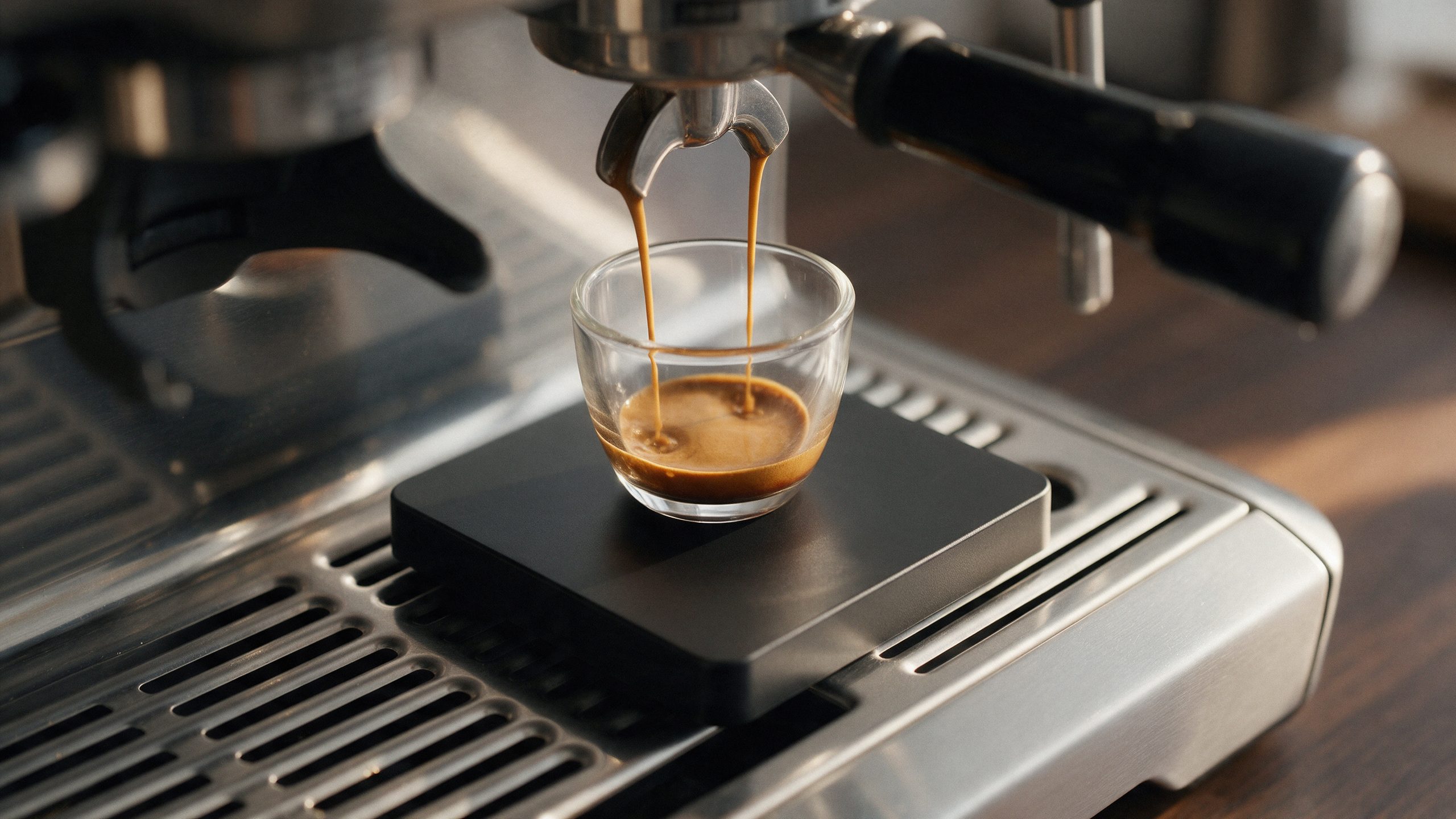
The best espresso scale is the one that fits where the shot happens: on the drip tray, under the spout, next to a group head that drips. A kitchen scale can weigh your beans. It can’t sit under a portafilter and keep up with a shot that runs for half a minute. This roundup picks five scales built for that spot, from $49.90 to $250. We haven’t weighed shots on them here, so every spec below comes from the manufacturer’s own page, and anything we infer from those specs is labeled as reasoning.
Short answer
For most people, the best espresso scale is the Acaia Lunar ($250): 105 mm square so it sits on most drip trays, espresso modes that start the timer on their own, a flow-rate readout, and a two-year warranty that covers water damage. If $250 is too much, the Wacaco Exagram Pro ($49.90) does the core job, auto-tare plus an auto-start timer, for a fifth of the price. Small drip tray? Measure it, then look at the 80 mm Bookoo Themis Mini.
Documented. Dimensions, capacities, modes, water ratings and prices come from each brand’s US store, checked in September 2026. Prices move, so read them as list prices on that date. Two brands leave a gap: Acaia gives the Lunar no IP rating, and Wacaco calls the Exagram Pro splash-proof without one either. Where a spec isn’t published, we say so instead of filling it in. Sections marked Reasoned explain why a spec matters at the machine; they are not results we measured. The method is on our how we test page.
The five picks at a glance
| Model | Footprint x height | Max load / readout | Espresso auto mode | Water | ||
|---|---|---|---|---|---|---|
| Acaia Lunar | $250.00 | 105 x 105 x 15 mm | 2,000 g / 0.1 g (0.01 g listed) | Auto timer + tare, flow rate | Water-resistant, no IP rating | Check price |
| Bookoo Themis Mini | $138.00 | 80 x 80 x 15 mm | 1,000 g / 0.1 g | Auto tare + start, flow rate | IPX4 | Check price |
| Varia AKU mini | $149.90 | 100 x 80 x 13 mm | 500 g / 0.01 g | Auto tare + timer, flow rate | IPX6 | Check price |
| Timemore Basic 3.0 | $59.00 | 140 x 120 x 20 mm | 2,000 g / 0.1 g up to 500 g | Auto tare + start, ratio | IPX3 | Check price |
| Wacaco Exagram Pro | $49.90 | 90 x 95 x 22 mm | 2,000 g / 0.1 g up to 999.9 g | Auto tare + timer | Splash-proof, no IP rating | Check price |
What an espresso scale does that a kitchen scale can’t
Reasoned. Size comes first. An espresso scale has to fit on the drip tray and still leave room above it for the cup. The five scales here run from 13 mm to 22 mm tall. That 9 mm gap sounds like nothing until your cup touches the spouts.
Then there’s speed. The usual starting recipe is about 18 g of coffee to 36 g of espresso in 25 to 30 seconds. Do the division and the cup gains roughly 1.2 to 1.4 g every second. A display that runs a second behind says 35 g when the cup already holds 36, and if you stop on that number you’ve pulled a longer ratio than you meant to. Over a week of mornings, that kind of drift is one of the quieter routes to over-extraction. None of the five brands publishes a response time in milliseconds, so lag is the one spec you can’t compare on paper. What you can compare is the automatic timer. All five start timing by themselves once weight lands in the cup, which frees a hand and takes the guesswork out of when the shot began.
Last, water. Espresso drips, the tray floods, and the scale sits in all of it. Three of the five publish an IP rating under the IEC 60529 standard: IPX3 (Timemore) is rated for spraying water, IPX4 (Bookoo) for splashing from any direction, and IPX6 (Varia) for powerful jets. Acaia and Wacaco describe their scales as water-resistant or splash-proof and stop there. Acaia does something more useful than a number, though: its warranty says in plain words that it covers water damage.
1. Acaia Lunar: best espresso scale overall
Documented. Acaia’s US store lists the Lunar at $250. It measures 105 x 105 mm, stands 15 mm tall and weighs about 265 g. It carries up to 2,000 g, and Acaia’s spec table gives readability as “0.1 g / 0.01 g” with a repeatability of 0.1 g, without saying when each step applies. Built-in espresso modes start and stop the timer or tare automatically, a Tare Save function remembers the weight of your dosing cup, and a flow-rate indicator shows how fast the shot is running. The body is anodized aluminum that Acaia calls water-resistant, with no IP rating. The 1,100 mAh battery charges over USB-C and is rated for 30 to 40 hours of continuous use. Bluetooth 5.0 connects it to Acaia’s apps. The box holds a heat-resistant pad and a 100 g calibration weight, and the two-year warranty includes water damage.
Reasoned. Read the spec sheet and the price starts to make sense. The Lunar is small enough for most drip trays, rated high enough at 2 kg to take a portafilter, and made of metal where most cheaper scales are plastic. The warranty is the line we’d weigh most. A scale that lives under a group head will get wet, and Acaia is the only brand in this group that puts water damage in writing. The catch is obvious: $250 buys five Exagram Pros. What the extra money gets you is durability and polish, not a better number on the display, and if you pull one or two shots a day you may never feel the difference.
2. Bookoo Themis Mini: for the smallest drip trays
Documented. Bookoo’s store lists the Themis Mini at $138, marked down to $129 when we checked. At 80 x 80 mm, 15 mm tall and about 140 g, it’s the smallest scale here. Capacity is 1,000 g with 0.1 g readability, and the flow-rate readout works in 0.1 g/s steps. There are three modes: Timer, Flow Rate, and Auto, which tares and starts by itself. The body is aluminum under tempered glass, rated IPX4. Bluetooth links it to Bookoo’s own app and to third-party apps including Beanconqueror, and Bookoo lists compatibility with machines and controllers such as Decent, Gaggiuino and Gaggimate. The 500 mAh battery is quoted at 24 hours of use, about two months per charge. The warranty is one year, extended to two if you register.
Reasoned. 80 mm is the number that sells this one. Compact machines tend to have narrow drip trays, and a 105 mm scale can overhang the edge or stop the tray from sliding out. When nothing else fits, try this first. The Bluetooth list is the second reason. If you run a modded Gaggia on Gaggiuino or Gaggimate, a scale the controller can read lets the machine act on the weight, for example to end the shot at a target. The 1,000 g ceiling is half the Lunar’s, which only matters if you like to set a full portafilter on the scale while you dose.
3. Varia AKU mini: the thinnest, and the most water-resistant
Documented. Varia lists the AKU mini at $149.90. It measures 100 x 80 mm and only 13 mm tall, the thinnest scale here, and weighs 165 g. It reads in 0.01 g steps up to 500 g. Varia names five modes, from fully manual to auto-tare with an auto-timer, plus a dedicated espresso mode, and a flow-rate display can be switched on in settings. The rating is IPX6. Bluetooth is there for firmware updates only; Varia doesn’t list an app. The 480 mAh battery gives up to 10 hours of brewing on a 2-hour USB-C charge, and the box includes a 100 g calibration weight and a travel case. Varia’s page doesn’t state a warranty term.
Reasoned. Two specs make this scale and one limits it. IPX6 is the best water rating in the group, and 13 mm is the lowest profile, which helps on machines where the cup barely clears the spouts. The limit is 500 g. That’s plenty for a cup and a shot, but if you dose into the portafilter on the scale, weigh your portafilter first, because a full-size one can use up most of that on its own. The 0.01 g readout is more precision than an espresso recipe asks for; nice to have, not a reason to buy. The battery is also the smallest here, so plan on charging it more often than the others.
4. Timemore Basic 3.0: if you brew pour-over too
Documented. Timemore’s US store lists the Basic 3.0 at $59, on pre-order when we checked; some US retailers sell the same scale as the Black Mirror Basic 3. It’s the largest scale here at 140 x 120 mm and 20 mm tall. It holds 2,000 g, but the readout gets coarser as the load goes up: 0.1 g from 0.2 to 500 g, 1 g up to 1,000 g, and 3 g up to 2,000 g. A slider switches between Regular, Pour-Over and Espresso modes. In Espresso mode the scale tares when you set the cup down, starts the timer with the first drop and shows the brew ratio. Timemore mentions a real-time flow rate without giving a figure. The rating is IPX3, and the 1,600 mAh battery is quoted at up to 24 hours of use with a 3.5-hour USB-C recharge. We found no warranty term on Timemore’s page.
Reasoned. This is a brewing scale that learned espresso, and the footprint gives it away. At 140 x 120 mm it won’t fit on a lot of drip trays, so measure before you order. If it does fit, the ratio display saves you the mental math on every shot, and the same scale handles a pour-over kettle on the weekend. The coarser steps above 500 g don’t touch espresso: a typical espresso cup plus a shot stays well under that, where it reads to 0.1 g. For under $60 that’s a lot of scale, provided your tray is big enough.
5. Wacaco Exagram Pro: best espresso scale under $50
Documented. Wacaco sells the Exagram Pro for $49.90. It measures 90 x 95 mm, stands 22 mm tall and weighs 155 g. It weighs from 0.3 g to 2 kg, in 0.1 g steps up to 999.9 g and 1 g steps above that. There are three modes: Normal, Pour-over with a ratio program, and Espresso, which tares and starts timing on its own once you start brewing. Wacaco calls the build splash-proof and gives no IP rating. The 700 mAh battery lasts up to 15 hours and recharges over USB-C in 2 hours. The warranty is two years, and a silicone pad and a carrying box come in the box.
Reasoned. At this price the Exagram Pro covers what an espresso scale can’t skip: a footprint most trays can take, a timer that starts with the shot, and 0.1 g steps where the shot lives. The trade-offs are the upper tier’s extras. Wacaco lists no flow-rate readout and no Bluetooth, and there’s no rating for how wet it can get. It’s also the tallest scale here at 22 mm, so check your cup clearance before anything else. For a first scale, or a second one that stays by the machine, it’s hard to argue with.
Measure your drip tray before you buy
Reasoned. Footprint rules out more scales than price does, so it’s worth two minutes with a ruler. Measure the flat part of the drip tray grate, side to side and front to back, and compare it with the footprints in the table. Then measure from the grate to the bottom of the spouts, subtract the height of the cup you actually use, and see which scales still fit in what’s left. On the big tray of a prosumer machine, anything here will work. On a compact machine, the Themis Mini at 80 mm wide and the AKU mini at 13 mm tall are the safe bets, and the Timemore is the one most likely to hang over the edge. If you’re still choosing the machine itself, our best espresso machines for beginners list each model’s overall dimensions.
Do you need Bluetooth and a flow-rate readout?
Reasoned. Not to make good espresso. Weight and time get you most of the way, and every scale here gives you both without a phone. Flow rate earns its place once you’re chasing consistency: a shot that suddenly speeds up halfway through is a hint of channeling, the same thing a bottomless portafilter shows you by eye. Bluetooth matters most when something else reads the scale, like an app that logs your shots or a machine controller that stops the shot by weight. If neither sounds like you, it’s a feature you’ll switch off to save battery.
Which one should you buy?
- You want one scale for years and the budget allows it: the Acaia Lunar.
- Your drip tray is small, or you want your scale talking to an app or a modded machine: the Bookoo Themis Mini.
- Your cup barely clears the spouts, or the scale is going to get soaked: the Varia AKU mini.
- You brew pour-over as well and your tray is large: the Timemore Basic 3.0.
- You want the basics done right for under $50: the Wacaco Exagram Pro.
Once the scale is on the tray, the numbers only help if you change one thing at a time. Our espresso dial-in chart shows which variable to move first, and the sour, bitter or burnt diagnosis table matches what’s in the cup to its likely cause.
Frequently asked questions
Do you really need a scale for espresso?
Reasoned. You can pull espresso without one, but you can’t repeat a good shot on purpose. Dose and yield are the two numbers espresso recipes are written in, and a shot glass with lines on it measures volume, foam included. A scale is the cheapest tool that turns “that was good” into something you can do again tomorrow.
Can I use a kitchen scale for espresso?
Reasoned. For weighing beans, yes, as long as it reads in 0.1 g steps. Under the portafilter, usually not. Most kitchen scales are too wide for a drip tray and aren’t built to get wet, and many round to whole grams, which is a big step on an 18 g dose.
Is 0.01 g better than 0.1 g for espresso?
Documented. The Varia AKU mini reads in 0.01 g steps, and Acaia lists “0.1 g / 0.01 g” for the Lunar; the other three read in 0.1 g steps. Reasoned. Espresso recipes are written to the gram, a tenth at most, so 0.1 g already gives you more detail than the recipe uses. The extra digit does no harm. It just isn’t worth paying extra for.
What do auto-tare and auto-start mean on an espresso scale?
Documented. Auto-tare zeroes the scale when you set the cup down; auto-start begins the timer when the first drops land. All five picks combine both in an espresso or auto mode, per their manufacturers. Reasoned. In practice you place the cup, start the shot, and watch one number instead of two buttons, which is the whole point of an espresso scale with a timer.
The short version
The best espresso scale fits your drip tray, starts its own timer and shrugs off the splashes. The Acaia Lunar does all of that with a metal body and a warranty that covers water, at $250. The Wacaco Exagram Pro does the essentials for $49.90. In between, pick on size: the Bookoo Themis Mini for the smallest trays, the Varia AKU mini for the tightest clearance, and the Timemore Basic 3.0 if you also brew pour-over and have the room. This page is built on manufacturer documentation, not a bench test we ran; see how we evaluate gear we haven’t bench-tested for the method.