Distilled Water for Espresso Machines: What the Manuals Actually Say
Distilled water stops new scale, which is why owners reach for it. Breville and De’Longhi both advise against it, and La Marzocco’s water spec starts well above zero. Here is the reasoning, and the fix.
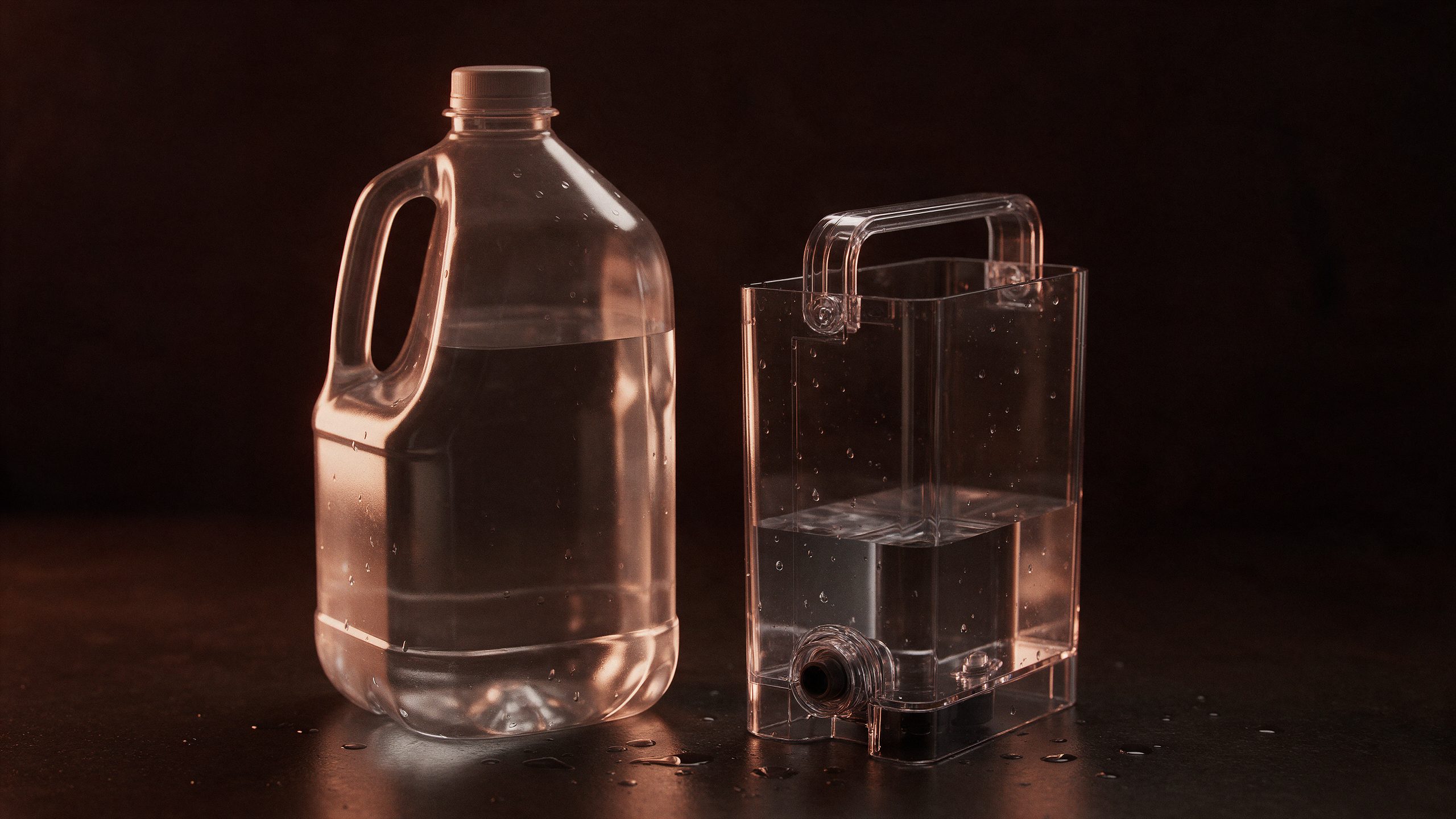
Using distilled water for espresso machine tanks sounds like the cleanest fix there is: no minerals in, no limescale out, no descaling ever again. The logic holds for the scale. It falls apart almost everywhere else. The manufacturers that address the question in writing mostly say no, and their reasons go past taste. Plain distilled water can confuse the sensors some machines use to find their own water level, and several sources in the trade call it hard on boiler metal. None of that makes the jug useless. It makes it an ingredient, and this page walks through what the documentation says, what is only reasoning, and how to use distilled water without working against the machine.
Short answer
Plain distilled water is a poor choice for most espresso machines. Breville’s manual advises against it, De’Longhi says the missing minerals flatten the coffee, and machines that sense water by conductivity can misread it. Distilled water with an espresso mineral blend added back is a different thing, and a reasonable one. Your own manual has the final word.
Reasoned. The appeal is easy to understand. Scale is calcium and magnesium carbonate left behind when hard water is heated, so water with no calcium or magnesium cannot leave any. Owners who have just paid for a descaling service, or who live on very hard tap water, do the math and buy the gallon jug. The math is right. It just answers only one of the three questions that matter, which are scale, taste, and how the machine itself behaves on water it was not designed around.
What manufacturers say about distilled water for espresso machine tanks
Documented. Breville puts it in the safety pages of the Barista Express (BES870) instruction manual, and repeats it in the first-use section: “We do not recommend the use of de-mineralized or distilled water.” The manual gives two reasons in the same sentence. It may affect the taste of the espresso, and it may affect how the machine is designed to function. What Breville asks for instead is cold, filtered water, with the tank’s own filter fitted.
Documented. De’Longhi is blunter. Its Coffee Lounge article on water quality asks whether distilled water can be used to make coffee and answers with a flat no. The explanation is about the cup: distilling removes magnesium, calcium and the other minerals the company calls essential to a smooth, balanced coffee, and with no mineral content at all the result is likely to taste flat or over-extracted. For owners in extremely hard water areas, the same page points to bottled water as the fallback, not distilled.
Documented. La Marzocco does not use the word “distilled” in its U.S. installation guide for the Linea Mini, but the water specification printed there makes the point with numbers. The company recommends that a filtration system produce water at 90 to 150 ppm total dissolved solids, 70 to 100 ppm total hardness and 40 to 80 ppm alkalinity, with a pH between 6.5 and 8 and chloride no higher than 30 ppm. Every one of the mineral ranges has a floor. Distilled water sits under all of them.
Reasoned. Three brands is not the whole market, and a manual for a different machine may say something different or nothing at all. The pattern is still worth noticing. An appliance maker, a bean-to-cup maker and a commercial-grade maker each land on the same side: some minerals, on purpose. This page is built on that documentation, not on a bench test we ran ourselves; our method page explains the difference.
The sensor problem: water the machine can’t see
Documented. This is the half of Breville’s warning, the one about how the machine functions, that most forum threads skip. Clive Coffee, a U.S. retailer that services prosumer machines, states in its water guidance that steam boiler fill probes use the conductivity of water to detect the level, and that with no dissolved solids the boiler can overfill, which gives you water at the wand instead of steam. Espresso Outlet, another retailer, says the same thing more cautiously: some water-level systems rely on conductivity, very low conductivity can interfere with them, and whether yours is affected depends on the model.
Reasoned. The physics is simple. Pure water carries almost no current, because the dissolved minerals are what carry it. A probe that decides “wet” or “dry” by passing a small current through the water has little to work with when the minerals are gone. Not every machine has such a probe. Many small single-boiler and thermoblock machines find an empty tank with a float or a different kind of sensor, and those have no reason to care about conductivity. That is why the question can’t be settled by a general rule, and why the manual for your machine outranks any article, including this one.
Does distilled water corrode the boiler?
Documented. Third Wave Water, which sells mineral packets meant to be mixed into distilled water, says on its support site that at higher temperatures and pressures, distilled water, like any water with nothing dissolved in it, can become corrosive and can damage a boiler. Keep in mind who is speaking: a company whose product is the cure. The claim is widely repeated in the trade, though, and it matches the reason La Marzocco sets minimums and a chloride ceiling in its spec.
Reasoned. We could not find a manufacturer document that puts a number on how fast mineral-free water attacks brass, copper or stainless steel in a home machine, so we won’t invent one. What can be said is narrower. Water with nothing dissolved in it and no alkalinity has no buffer, so it picks up whatever it touches more readily than balanced water does. Whether that shortens the life of a given boiler depends on the metal, the temperature and years of use. It is one more factor on the list we cover in how long espresso machines last, and not a reason to panic over a single gallon.
How to use distilled water without the downsides
Documented. Third Wave Water makes the distinction itself: once you add minerals to distilled water, it is no longer distilled. It is mineral water built to a recipe. That is the legitimate use of the jug. You start from a known zero and add a measured dose, so the water going into the tank is the same every week, whatever the city does to the tap supply.
Reasoned. Two cautions apply. First, pick a blend made for espresso. Espresso Outlet’s warning is fair: a mineral packet formulated for filter coffee is not automatically right for a boiler, and a “coffee water” label does not override what the machine’s maker specifies. Second, a recipe mixed at home from pantry ingredients moves the responsibility to you. If you go that way, measure by weight, and check the result against the range your manual or manufacturer publishes. Our guide to water filters for espresso machines covers the other route, which is to take minerals out of tap water instead of adding them to empty water.
| Water in the tank | Scale risk | What the sources above say |
|---|---|---|
| Plain distilled or demineralized | None from the water itself | Breville and De’Longhi advise against it; conductivity probes may misread it; below La Marzocco’s minimums |
| Plain reverse-osmosis water | Very low | Same concerns as distilled when little mineral content is left |
| Distilled plus an espresso mineral blend | Low, set by the recipe | No longer “distilled”; check the blend against your manual |
| Filtered tap water | Depends on local hardness | What Breville’s manual asks for; a softening filter matters on hard water |
| Bottled water | Depends on the brand | De’Longhi’s fallback for very hard water areas; read the mineral analysis on the label |
Is purified water any different?
Reasoned. “Purified” on a U.S. label usually means the water went through reverse osmosis, deionization or distillation, so for an espresso machine it raises the same questions as distilled: very little mineral content, very little conductivity. Some bottlers add minerals back for taste, which changes the picture, and the label will say so. Spring water is the opposite case. It carries minerals by nature, sometimes a lot of them, and two brands can differ widely. The useful habit is the same for every bottle: find the mineral analysis, and compare it with the range your machine’s maker publishes.
Do you still need to descale?
Reasoned. Switching to mineral-free or low-mineral water stops new scale from forming. It does nothing about scale already inside the machine, which stays put until an acid descaler dissolves it. If the machine ran on hard tap water for a year before the switch, it still owes you one proper cycle, done the way the manual describes. We cover that in how to descale an espresso maker.
Reasoned. After that, follow the schedule your manufacturer sets, even if the water is soft. Many machines prompt for descaling on a counter or a hardness setting, and the manual’s interval is the one a warranty conversation would start from. Skipping it because “the water has nothing in it” is a judgment call the documentation does not make for you. Descaling also has nothing to do with coffee oil, which builds up no matter what water you use; that is a separate job, explained in cleaning vs. descaling.
The short version
Reasoned. Plain distilled water solves scale and creates three new questions: flat-tasting shots, sensors that may not register it, and a corrosion risk nobody has put a clean number on. The makers who address it in writing say not to use it. If hard tap water is the real problem, the better answers are a softening filter matched to your hardness, or distilled water rebuilt with an espresso mineral blend so it lands inside your manufacturer’s range. Read the water section of your own manual before you change anything. It takes two minutes, and it is the only source that knows which sensors your machine has.