How to Descale an Espresso Maker, Whatever the Brand
Descaling an espresso maker is the same job on every brand: an acid solution through the boiler and water path, then a full rinse. The method the manuals agree on, what they forbid, and when not to run it.
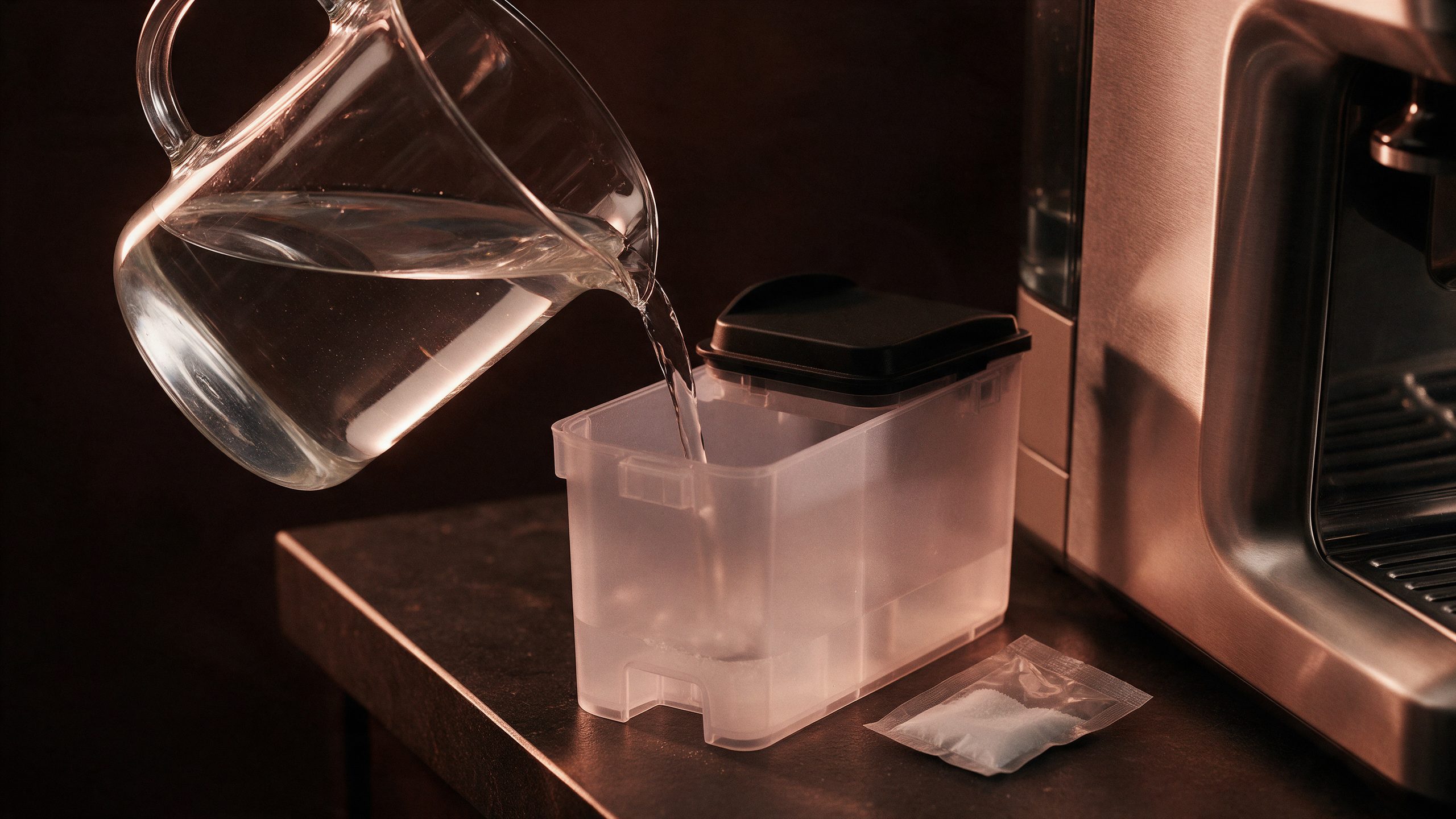
Every espresso machine manual describes the same job under a different set of buttons. Learning how to descale an espresso maker, whatever the brand, comes down to one procedure: an acid solution goes through the boiler or thermoblock and the water path, sits long enough to dissolve mineral scale, and a full tank of fresh water rinses it back out. The button sequence changes from a Breville to a Philips to a Gaggia. The chemistry, the order of operations, and the mistakes do not. This page covers the method the manuals agree on, what they forbid, and the one case where the right move is not to descale at all.
Short answer
Remove the water filter, dissolve the manufacturer’s descaler in the tank at the ratio printed on the packet, put the machine in its descale mode, run the solution through the coffee side, steam wand, and hot water outlet until the tank is nearly empty, then refill with fresh water and run the same cycle again to rinse. Never pull the tank mid-cycle, never use vinegar unless your manual names it, and never descale a machine with a separate steam boiler without checking what its maker says first.
Reasoned. A generic guide can exist because scale is the same substance in every machine: calcium and magnesium carbonate, set by heat on the heating element, the boiler wall, and the narrow tubing behind the group. A weak acid turns it back into something water can carry away. Every button a manual tells you to press is there to move that acid through the same hot, narrow places and then get it out again.
What descaling fixes, and what it can’t touch
Documented. Breville’s instruction book for the Barista Express (model BES870XL) spells out what is at stake: with regular use, hard water leaves mineral build-up on the inner components, and the manual lists the consequences as reduced brewing flow, lower brewing temperature, less power from the machine, and worse-tasting espresso. Its troubleshooting table points back to descaling for four separate complaints: no water from the group head, espresso that only drips, no steam, and coffee that isn’t hot enough.
Reasoned. What it cannot touch is coffee oil. That film is organic and needs an alkaline cleaner backflushed through the group, a job Breville flags with a different behavior of the same light: flashing for the cleaning cycle, solid for descale. If your shots taste flat but flow and temperature are normal, descaling will not help. Cleaning versus descaling lays out why the two jobs run on opposite chemistry.
What goes in the tank: the chemistry every descaler shares
Documented. Urnex publishes an ingredient disclosure for its Dezcal descaler: citric acid and sulfamic acid as the cleaning agents, a sodium salt as a buffer, aluminum sulfate as a flocculant, and hydrated silica as a processing aid. The product page gives the dose as 200 grams of powder per 3.9 liters of warm water and notes that this version is meant for commercial equipment, with separate products for household machines. Breville’s sachets are dosed differently: one sachet in 34 fl oz (1 liter) of water, per the Barista Express manual. Philips goes further and names a single approved product, its CA6700 descaler.
Reasoned. Three brands, three bottles, one idea: a buffered weak acid at a ratio the maker has tested against its own seals and metals. The ratio is the part people improvise on, and it is the part that matters. More powder does not dissolve scale usefully faster; it puts a stronger acid against brass, aluminum, and silicone for the same number of minutes. Follow the packet, not a forum.
Vinegar, citric acid, and baking soda
Documented. Philips is unusually blunt on substitutes. Its descaling page for the Espresso 2300 and 3300 series states that products containing sulfuric, hydrochloric, sulfamic, or acetic acid (which is vinegar) must not be used, because they damage the machine and void the warranty. Note the overlap: sulfamic acid is on Philips’ banned list and inside Urnex Dezcal at the same time. A descaler that is fine in one machine can be a warranty problem in another, which is the strongest argument for using what your own manual names. Urnex itself describes vinegar as slow to work, hard to rinse, and prone to leaving an odor and aftertaste.
Reasoned. Plain citric acid has the best case of the substitutes: it is the main cleaning agent in Dezcal, it is cheap, and it rinses cleanly. What it lacks is the buffer and the tested ratio, and no manual opened for this page endorses it by name. Baking soda is a different story. It is alkaline, and carbonate scale does not dissolve in an alkaline solution, so a baking soda “descale” rinses the tank and does nothing to the boiler.
How to descale an espresso maker, step by step
Documented. The sequence below is assembled from two published procedures, Breville’s Barista Express instruction book and Philips’ descaling page for its 2300 and 3300 series. Where the two disagree on a detail, that detail belongs to your manual, not to this page.
- Confirm the machine is asking for a descale, not a clean. On the Barista Express the CLEAN/DESCALE light is solid for descale and flashing for the cleaning cycle; Philips machines show a steady Calc/Clean light or an on-screen prompt.
- Empty the drip tray and take the water filter out of the tank. Philips removes the AquaClean filter and fits a new one afterward; Breville’s manual pulls the filter whenever anything but tap water goes through the tank.
- Dissolve the descaler at the printed ratio. Breville: one sachet in 34 fl oz (1 L) of water, then fill the tank. Do not double it.
- Enter descale mode. On the Barista Express, hold the 2 CUP button and then POWER together until the machine heats and its four indicators are all solid. Menu-driven machines put the same step under a settings screen.
- Run the solution through every outlet with a large container under the group and the wand. Breville’s cycle pushes it through the coffee side, then the steam wand, then the hot water outlet, and repeats those passes until the tank is down to roughly half a liter.
- Do not stop halfway. Breville warns never to remove or fully empty the tank during descaling, and its descale mode times out after five minutes of inactivity. Philips says an interrupted cycle can leave the machine repeating its descaling request.
- Rinse with a full tank of fresh water. Breville: rinse the tank, refill to the 68 fl oz (2 L) maximum with cold water, and repeat the same passes until it is gone. Philips builds the rinse into a guided cycle of about 30 minutes.
- Exit descale mode, refit the filter, and pull a shot you intend to throw away. If it tastes sharp or smells of descaler, run another tank of water.
| Step | Breville Barista Express manual | Philips Espresso 2300/3300 page |
|---|---|---|
| Signal to descale | CLEAN/DESCALE light solid (flashing means cleaning cycle) | Calc/Clean light on steadily, or an on-screen prompt |
| Product | Breville descaling powder, one sachet per 34 fl oz (1 L) | Philips CA6700 descaler only |
| Filter | Removed when running anything but tap water through the tank | AquaClean filter removed, replaced with a new one after |
| Outlets covered | Coffee side, steam wand, hot water, repeated until the tank is nearly empty | Guided cycle runs until the tank empties |
| Rules | Never remove or fully empty the tank mid-cycle; mode times out after 5 minutes | Never interrupt the cycle; forbidden acids void the warranty |
| Rinse | Full 68 fl oz (2 L) tank of fresh water through the same passes | Rinse cycle built in, about 30 minutes total |
Before you pour acid into a boiler machine
Reasoned. Everything above assumes a thermoblock or a single small boiler that the cycle can flush completely. Heat exchanger and dual boiler machines are different. The steam boiler holds a volume of water that a flow-through cycle never fully replaces, so acid can sit in it, against brass fittings, a level probe, and a heating element. That is why the makers of these machines tend to talk about water quality first and descaling last, if at all.
Documented. La Marzocco Home’s water guidance for its domestic machines never mentions descaling. It sets a target of 90 to 150 ppm total dissolved solids, names bottled waters inside that range, and adds two habits instead of a chemical: switch the machine off if it will sit unused for 36 hours, and drain the steam boiler every two months so fresh water keeps moving through it. The same page warns that water with too little mineral content, distilled water included, can damage parts through leaching and can trip a false “reservoir empty” alert on machines that sense water by its conductivity.
Reasoned. If you own a heat exchanger or dual boiler machine and the maker’s documentation does not describe a user descale, treat that silence as an instruction. Fix the water going in, drain the steam boiler on the maker’s schedule, and leave the acid to a technician who can open the boiler and flush it properly. What a water filter actually removes covers the prevention side; Breville’s own manual makes the same point for its thermoblock machines, noting that changing the tank filter every two months reduces how often a descale is needed at all.
How to tell it’s time before the light does
Reasoned. The indicator on a consumer machine counts usage; it does not measure scale. Two owners of the same machine will have very different boilers if one runs soft municipal water and the other hard well water. The earlier tells are the ones in Breville’s troubleshooting table: flow that slows shot after shot with no change in grind, steam that builds slower and weaker, cups that run cooler than they used to. A gauge that fades over weeks is another, covered in why an espresso machine loses pressure. For a schedule, start from a hardness test strip or your utility’s water report rather than a calendar; descaling a Breville and descaling a De’Longhi show how each maker turns that hardness into an interval.
The mistakes that undo a good descale
Reasoned. Most descaling problems are not about the acid but about what happens around it. Running the cleaning-tablet cycle and calling it a descale is the most common, since both routines live behind the same light on many machines. Leaving the filter in the tank spends part of the dose on the cartridge. Cutting the rinse short is the mistake you taste: acid left in the hot water line rides out in the next few shots. Doubling the powder because the machine “really needs it” only raises the concentration the seals see. And running a backflush straight after a descale, without a clear-water rinse between them, puts acid and alkali in the same plumbing for no gain.
When it’s worth calling a technician
Reasoned. A descale cycle run by the book, with the maker’s product and a full rinse, is a reversible, low-risk job on any thermoblock or single boiler machine. Three situations are not. A machine that will not enter its descale mode, or keeps dropping out of it, has a problem upstream of the routine that more acid will not fix. A heat exchanger or dual boiler machine run for years on hard water has scale in a boiler the cycle cannot reach, and only a technician with the boiler open can clear it without leaving acid inside. And flow that stays restricted after a complete descale and rinse points to a flow restrictor, a solenoid, or a pump rather than soluble scale. In all three cases, unplug the machine, stop adding chemicals, and follow the manufacturer’s service route. Opening the boiler yourself can void the warranty and puts you next to a pressure vessel that was hot a few minutes ago.